


Biodiversity Call
Karl Sterner Isaksson, or Kalle as he is usually called, is responsible for the day-to-day operations at Klimatkoll, an organisation that develops various games with a focus on educational and entertaining learning activities. Together with Erik Sterner, a researcher at Environment for Development at the University of Gothenburg, and member of BECC, among others, they have now developed a new game: Biodiversity Call.
Tell us about Biodiversity Call

Biodiversity Call is a card game that, although having a serious undertone in the context of the biodiversity crisis, is based on curiosity and allows players to explore the global status of various species in a simple and fun way. The questions in the game are based on research conducted at BECC, as well as research that forms the basis for the work of the International Union for Conservation of Nature (IUCN).
Why is there a need for a game like Biodiversity Call?
We need to explore different approaches to increase awareness and knowledge about biodiversity, encouraging people to make it a priority, both on a large and small scale. Alongside integrating facts into the game, we also share simple tips on what players can do in their everyday lives to support biodiversity – which we believe can be a step towards meaningful change.
You have previously developed Climate Call, a similar card game focusing on the climate crisis, which has been successful. What are your experiences from that?
There are many. But the most important lesson is that it can be fun to discuss even sensitive issues such as climate change if you find the right approach, regardless of the context. We have also leveraged this in Biodiversity Call.
Who is the game aimed at?
The game is designed for everyone aged 12 and up. It works equally well for teenagers as it does for professionals and experts. The conversations will of course be different, and our focus will be very much on empowering secondary school teachers to give their students an inspiring introduction to biodiversity. Similar to Climate Call, we are creating lesson plans and tips to help teachers delve deeper into topics of the game.
Finally – how do I get hold of the game?
With support from BECC, some free games will be distributed to teachers, nature centres, and botanical gardens. Starting January 2026, it will also be available for purchase in both Swedish and English through our web shop and elsewhere.
Zero Waste Roadmap Game
Jagdeep Singh is a researcher at Centre for Environmental and Climate Science (CEC) and a member of BECC. In his research, Jagdeep focuses on sustainable production and consumption and the circular economy, among other topics. He is also interested in game theory, which he combined with his scientific expertise to create the game Zero Waste Roadmap.
Tell us - what kind of game is this?
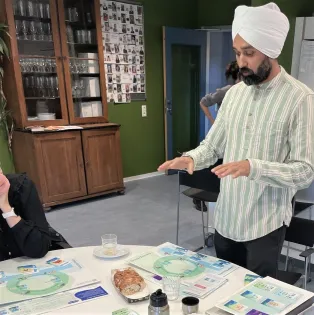
The main motivation behind this project is to transform concepts like circular bioeconomy, sustainability transitions, and governance into a game format. This has now resulted in a board game focusing on how we can improve the management of organic waste.
Who is the game aimed at?
The game has three main target groups:
- University students with interests in circular economy, sustainability transitions, governance, and policymaking.
- Societal stakeholders (e.g., people within waste management, policymakers, etc.) to engage them in waste management planning and identify critical areas for improvement.
- School children (age 13 and up), to educate them about the importance of waste sorting, and other concepts such as circular economy and sustainability transitions.
What research forms the basis of the game?
The game is designed based on the principles of gamification and informed by techniques and methods for managing organic waste. A key feature is to weave in policy, especially the policies that govern and dominate the waste management sector globally. To represent developed and developing countries, insights from ten interviews with experts in the sector in Sweden and India were used in the game's design process.
After testing the game with different players, what kind of feedback have you received so far?
The game has officially been played twice: with experts in the field and with teachers and students. So far, the feedback is positive. Most teachers and experts who tried the game find it inspiring and want to introduce it in their courses as teaching materials, and most students want to introduce it to their friends/fellow students. But the feedback also gave me insights into how the game could be further refined.
Finally - how do I get hold of the game?
At the moment, it cannot be purchased but only played with me as a facilitator. Hopefully, we can introduce it in different ways to students, stakeholders and schoolchildren.
The future plan is to develop an online version, making it accessible to a wider audience.